
Lamayuru Monastery
A thousand year old Drikung Kagyu monastery at 3,510 metres on the Srinagar Leh Highway, surrounded by the lunar erosion formations locals call Moonland, and home to the annual Yuru Kabgyat masked dance festival
- Buddhist Monastery
- ~3,510 m / 11,520 ft
- 125 km from Leh
- Srinagar Leh Highway
- May to Oct
What makes it special
Lamayuru is probably the oldest monastery in Ladakh, and it looks the part. The gompa sits on a rocky outcrop above a small village on the Srinagar Leh Highway, roughly 125 km west of Leh, surrounded by a landscape so strange that the first time you see it, your brain takes a second to process what it is looking at. The hills around the monastery are deeply eroded clay and sandstone formations, pale yellow and grey, with ridges and craters and soft crumbling shapes that genuinely look like something out of a lunar photograph. Locals and guidebooks call it Moonland, and the name sticks because nothing else quite describes it. The monastery, with its whitewashed walls and old wooden balconies, sits in the middle of all this like something placed there deliberately to contrast with the emptiness around it.
The formal name is Yungdrung, meaning "eternal" in Tibetan, a word closely tied to the Bon tradition that predated Buddhism in this region. According to local tradition, Lamayuru was originally a Bon site before being converted. The monastery as it stands today is affiliated with the Drikung Kagyu school of Tibetan Buddhism. The Indian scholar and mystic Naropa (roughly 956 to 1041 CE) is credited with establishing the monastery in the 11th century. A popular legend says the valley was once filled by a lake, and when the water receded, Naropa found a dead lion at the exposed site and built the first temple there, called Seng ge Sgang, or Lion Mound. Of the five original structures he is said to have built, only one survives. The oldest standing building is a temple attributed to Rinchen Zangpo, the great translator monk who was active in the same period.
At its peak, the monastery housed about 400 monks. Today, roughly 50 live within the complex, with another 150 or so in the village below. The scale has shrunk, but the atmosphere has not. The main assembly hall, the Dukhang, has walls covered in old paintings of Buddhist deities, some faded and cracking but still powerful. The Gonkhang (protector temple) is darker and more intense, dedicated to the guardian figures of the faith. A small temple holds statues of Avalokitesvara with a thousand arms and eleven heads, Padmasambhava, and the eight Bodhisattvas. Next to the main complex, you can visit Naropa's cave, a small glassed in space where the sage is believed to have meditated. It is one of those places where the age of the building and the stillness of the room do the talking. No theatrics needed.
Most travellers encounter Lamayuru as a stop on the two day Srinagar to Leh drive, usually on day two after an overnight in Kargil. The monastery sits right on the highway, and the village has enough guesthouses and homestays that you can spend a night if you want more than a roadside photo. That is the recommendation. An hour at the monastery is fine for the temple visit, but you need late afternoon light to really see the Moonland formations at their best, when the low sun throws long shadows across the ridges and turns the clay a warm gold. If you are driving from Leh as a day trip, the round trip takes about 6 to 7 hours with time at the monastery, which is a long day but doable.
One thing worth knowing: Lamayuru sits on the Srinagar Leh Highway and does not fall within any restricted area. No Inner Line Permit is needed to visit. This makes it one of the easiest major monasteries in Ladakh to reach for both Indian and foreign travellers.
Quick answers
- What is Lamayuru Monastery and why do people visit?
- Lamayuru is the oldest monastery in Ladakh, roughly a thousand years old, at 3,510 metres on the Srinagar Leh Highway about 125 km from Leh. People visit for the monastery's old wall paintings, Naropa's cave, and the Moonland, the surreal eroded landscape that looks like another planet. Most stop on the Srinagar to Leh drive. Worth an overnight for Moonland light.
- How long should I spend at Lamayuru?
- An hour for the monastery. Half a day with the Moonland walk. Ideally, spend a night to see the landscape at sunset and sunrise. Most people who rush through in 45 minutes wish they had stayed longer.
- Do I need a permit for Lamayuru?
- No. Lamayuru is on the Srinagar Leh Highway outside any restricted area. No ILP or PAP needed. This applies to both Indian and foreign nationals.
Quick facts
Everything you need to know at a glance.
At a glance
- Altitude
- 3,510 m / 11,520 ft. Acclimatise in Leh for at least a day, or spend a night in Kargil on the Srinagar route.
- Location
- On the Srinagar Leh Highway (NH1), about 125 km west of Leh. Sham Valley, western Ladakh.
- Buddhist affiliation
- Drikung Kagyu school. Previously a Bon site. Also known as Yuru Gompa or Tharpa Ling ("place of freedom").
- Founded
- 11th century CE, attributed to Naropa (956 to 1041 CE). Oldest building attributed to Rinchen Zangpo.
- Timings
- Generally 8 AM to 5 PM. Can shift during festivals or winter. Confirm locally outside peak season.
- Entry fee
- Roughly INR 50 per person as of recent reports. Carry small cash.
- Time needed
- 1 to 2 hours for the monastery. Half a day with Moonland. Overnight stay ideal.
On the ground
- Mobile network
- Very weak. BSNL postpaid has the best chance. Jio and Airtel essentially dead. Download offline maps.
- Food
- Basic dhabas and guesthouse kitchens. Thukpa, momos, dal rice. Carry snacks if particular.
- Accommodation
- Guesthouses from around INR 1,500 per night. Basic but clean. Book ahead during festival season.
- Fuel
- No fuel pump in Lamayuru village. Nearest pump is at Khalsi, about 22 km toward Leh. Leh is 125 km, Kargil 110 km.
- Photography
- Allowed outside and most of the complex. Not inside the main prayer hall. Ask before photographing monks.
- Permits
- None required. On the main highway, outside any restricted zone.
- Washrooms
- Basic public washroom near the monastery. Guesthouses are a better option.
- Drones
- No specific prohibition, but drone rules in Ladakh are evolving. Check current regulations.
Seasonal weather
- May to Jun20°2°Late spring (May to Jun)
- Jul to Aug25°8°Summer (Jul to Aug)
- Sep to Oct18°0°Autumn (Sep to Oct)
- Nov to Apr5°-15°Winter (Nov to Apr)
Suitable for
- Couples — suitable
- Families — suitable
- Seniors — with some care
- Solo — suitable
- First-timers — suitable
- Pet-friendly — not suitable
How to reach Lamayuru Monastery
2 approach routes, with seasonal access.
From Leh
Year round from Leh side, though passes can close briefly after heavy winter snow.- Distance
- About 125 km
- Time
- 3 to 3.5 hours
- Road
- Tarred highway (NH1). Good surface for most of the route.
- Last fuel
- Fill up in Leh. There is a fuel pump at Khalsi, about 22 km before Lamayuru.
Leave Leh early, ideally by 7:30 to 8 AM. The road follows the Indus downstream on NH1, passing Magnetic Hill and Gurudwara Pathar Sahib. Cross the Indus Zanskar confluence viewpoint at Nimmu, continue through Khalsi, and carry on west to Lamayuru. The monastery appears suddenly as you round a bend. Fotu La pass sits further west beyond Lamayuru toward Kargil, so you do not cross any major pass on this route. Allow 3 to 3.5 hours each way, giving 2 to 3 hours at the monastery.
From Kargil (Srinagar to Leh drive)
Generally May to October. Opens once Zoji La is cleared, usually late May.- Distance
- About 110 km
- Time
- 2.5 to 3 hours
- Road
- Tarred highway (NH1). Generally good with rough patches near passes.
- Last fuel
- Fill up in Kargil. There is also a pump at Khalsi, about 22 km past Lamayuru toward Leh.
The natural stop on day two of a Srinagar to Leh drive. Most travellers overnight in Kargil, then drive toward Leh. Lamayuru comes about 2.5 to 3 hours into this drive, after Namika La and Fotu La. You arrive around midday. If you can, stay the night and continue to Leh the next morning for the Moonland sunset and sunrise.
Best time to visit
Season by season, so you can plan around the weather rather than hope.
- Recommended
Late spring
May to June
Road opens, light crowds, clear skies. Best balance of access and quiet.
- Temperature
- 2 to 20°C
- Road from Srinagar
- Opens late May (Zoji La dependent)
- Road from Leh
- Open
- Crowds
- Low
The Srinagar Leh Highway usually opens by late May once Zoji La is cleared. Lamayuru is accessible from Leh even earlier. Temperatures are comfortable during the day but drop near freezing at night. Tourist numbers are still low and you can often have the monastery courtyard to yourself in the early morning. The Moonland formations look their sharpest in the clean spring light.
- Recommended
Summer
July to August
Warmest months, Yuru Kabgyat festival window, busy with highway traffic.
- Temperature
- 8 to 25°C
- Crowds
- Moderate to high, peak during Yuru Kabgyat
- Festival
- Yuru Kabgyat usually late June to early July (confirm dates locally)
- Road
- Fully open from both sides
Warmest window and most popular. Daytime temperatures can reach 25 degrees. This is when the Yuru Kabgyat festival usually falls (dates follow the Tibetan lunar calendar, generally late June to early July). Outside festival days, summer brings steady highway traffic. Village guesthouses fill up, so book ahead in July.
- Recommended
Autumn
September to October
Sharp light, thin crowds, cold nights. Best photography window.
- Temperature
- 0 to 18°C
- Crowds
- Low
- Road
- Open
- Photography
- Best light of the year
Tourist numbers drop noticeably and the light gets exceptional. Clear skies, long shadows, and the Moonland formations at their most dramatic. Daytime temperatures still comfortable but nights touch zero or below by October. Highway still fully open. If you care about photography more than festivals, this is the window.
Winter
November to April
Accessible from Leh, but cold, isolated, and the Srinagar route is closed.
- Temperature
- -15 to 5°C
- Road from Srinagar
- Closed (Zoji La snow)
- Road from Leh
- Usually open, passes can close briefly
- Tourist infrastructure
- Mostly shut down
The Srinagar route closes once snow blocks Zoji La, usually by November. From Leh, the road generally stays open, though passes can close temporarily. Temperatures crash to minus 10 to minus 15 at night. Most guesthouses shut down. The monastery remains active but visitor facilities are minimal. For experienced travellers who want silence and the snow covered Moonland.
Things to see & do
5 things worth your time at Lamayuru Monastery.
Walk through the monastery complex
45 minutes to 1 hourStart at the main courtyard and work your way through the Dukhang (assembly hall), where the walls are covered in old Buddhist paintings, some cracking with age but still vivid in the dim light. The Gonkhang (protector temple) is darker, smaller, and more intense. Look for the statues of Avalokitesvara with a thousand arms, Padmasambhava, and the eight Bodhisattvas in the smaller temple. Remove your shoes before entering any prayer hall. No photography inside the main prayer hall, and always ask before photographing monks.
Visit Naropa's meditation cave
10 minutesA small glassed in cave next to the main temple complex, believed to be where the 11th century scholar Naropa meditated. The cave is modest in size and there is not much to see physically, but it is one of those spots where the history of the place concentrates into a single point. Worth a few quiet minutes.
Walk the Moonland formations
30 minutes to 1.5 hoursThe eroded landscape right next to the monastery is the other reason people come to Lamayuru. Walk through and around the formations on informal trails. The terrain is soft clay, so watch your footing. Late afternoon is the best time, when the sun drops low and throws long shadows across the ridges. Early morning works too for photography. The walk is easy and flat, no climbing required, but altitude means you will move slower than you expect.
Attend the Yuru Kabgyat festival (seasonal)
Full day (2 day festival)The annual Yuru Kabgyat is a two day masked dance festival held at the monastery, usually in late June or early July (dates follow the Tibetan lunar calendar and shift yearly). Monks from surrounding gompas gather for Cham dances in elaborate masks, accompanied by drums, cymbals, and the deep sound of the dungchen. If you are in Ladakh during this window, it is one of the most genuine cultural events you can witness. Book accommodation well in advance.
Overnight in Lamayuru village
Evening to morningStaying the night changes the experience. After highway traffic thins in the evening, the village goes quiet. Watch sunset light on the Moonland from a guesthouse rooftop. The sky after dark is packed with stars. Morning light on the monastery and valley is worth an alarm. Guesthouses serve simple meals and rooms are basic but functional.
Know before you visit Lamayuru Monastery
The practical bits, from people who have been.
What Lamayuru actually isA thousand year old working monastery on the Srinagar Leh Highway, surrounded by the Moonland. Most people stop for an hour. It rewards more time.
Lamayuru is a working Drikung Kagyu monastery, not a museum. About 50 monks live here. It sits on the Srinagar Leh Highway at 3,510 metres, so most travellers encounter it on the two day Srinagar to Leh drive. The monastery itself is worth an hour. But the real draw is the Moonland: the eroded clay landscape surrounding the gompa that looks genuinely alien. If you only pass through for 30 minutes, you will see the monastery but miss the landscape. Give it at least half a day, ideally an overnight.
How to fit Lamayuru into your tripStop here on the Srinagar to Leh drive, or do a day trip from Leh. An overnight is the best option.
The most common way to visit is on the Srinagar to Leh drive. You leave Kargil in the morning, cross Namika La and Fotu La, and reach Lamayuru around midday. Most people stop for an hour and continue to Leh. The better plan is to stay the night and drive to Leh next morning, giving yourself sunset and sunrise on the Moonland.
From Leh, it works as a day trip (about 125 km, 3 to 3.5 hours each way). The road heads west along the Indus through Nimmu and Khalsi before reaching Lamayuru. Combine it with stops at the Indus Zanskar confluence and Magnetic Hill. You can also pair it with Alchi Monastery, about 50 km closer to Leh on the same highway.
If you have a longer Ladakh itinerary that includes Nubra Valley and Pangong Lake, slot Lamayuru in as either the first or last day, depending on whether you entered Ladakh by road or by air.
Altitude and who should reconsiderAt 3,510 m, lower than most Ladakh passes but still high enough to cause symptoms if you are not acclimatised.
If you arrive from the Srinagar side, you will have already spent a night in Kargil at a similar altitude, so acclimatisation is usually not an issue. From Leh, one full day of acclimatisation at 3,500 metres is enough.
Seniors with heart, lung, or blood pressure conditions should consult a doctor before any trip above 3,000 metres. The monastery involves uphill walking on uneven stone paths and steep stairs, which can be hard for people with mobility issues. The Moonland walk is flat but at altitude.
Families with children visit regularly and the monastery is safe and welcoming. Pets are not practical. The monastery is an active religious site and the village has no pet friendly infrastructure.
Practical details that matterNo permit. Entry roughly INR 50. No fuel in the village, nearest pump at Khalsi (22 km). Weak mobile network. Basic accommodation available.
No permit required. Entry roughly INR 50. Generally open 8 AM to 5 PM. Remove shoes in prayer halls. No photography inside the main prayer hall.
No fuel pump in Lamayuru village. The nearest pump is at Khalsi, about 22 km toward Leh. Alternatively, fill up fully in Leh or Kargil before setting out. Mobile network is very weak. BSNL postpaid has the best chance. Download offline maps before leaving.
Guesthouses from around INR 1,500 per night. Basic rooms, simple meals. Book ahead during the Yuru Kabgyat festival in summer.
Nearby attractions
Other places worth the detour.
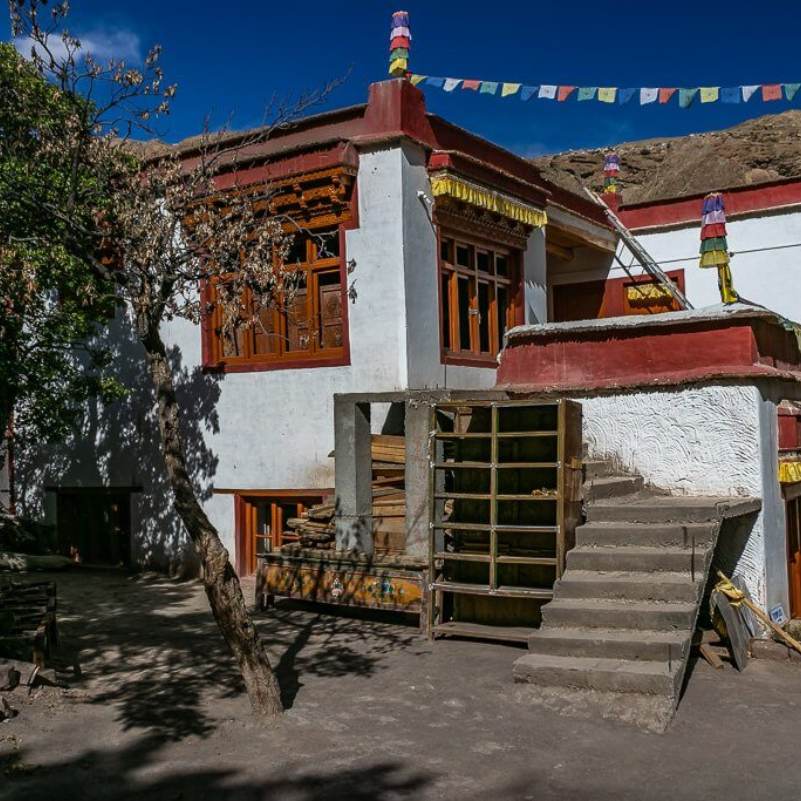
Alchi Monastery
About 50 km toward Leh
One of the most important Buddhist heritage sites in Ladakh, known for remarkably preserved 11th century wall paintings. Unlike most Ladakh monasteries, Alchi sits at river level. A natural pairing with Lamayuru on a Leh day trip. No photography inside.
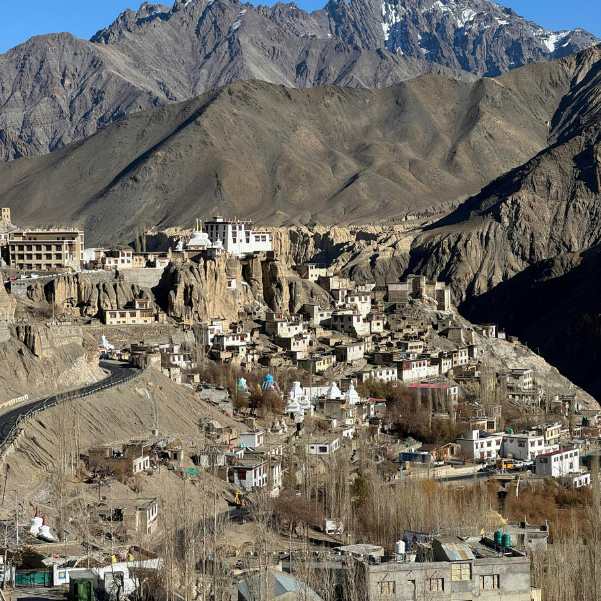
Moonland formations
Adjacent to the monastery
The eroded clay and sandstone landscape right next to the monastery, with ridges and craters that genuinely look like a lunar surface. Walk the informal trails in late afternoon for the best light.
Wanla Monastery
About 12 km from Lamayuru
A smaller, quieter monastery in nearby Wanla village, with 11th century paintings attributed to Rinchen Zangpo. Far fewer visitors than Lamayuru.
Fotu La Pass
About 15 km toward Kargil
The highest point on the Srinagar Leh Highway at roughly 4,100 metres. Located between Lamayuru and Kargil, you cross it when arriving from the Kargil side or continuing westward from Lamayuru. A quick photo stop.
Indus Zanskar Confluence
About 75 km toward Leh
Where the Zanskar River meets the Indus, visible from a viewpoint near Nimmu. The two rivers show different colours where they merge. A natural stop on the Leh drive.
Khardung La Pass
About 160 km via Leh
One of the most iconic high altitude passes near Leh, on the route to Nubra Valley and Diskit Monastery. A separate day trip from Leh if your itinerary covers both western and northern Ladakh.
Our packages with Lamayuru Monastery
Curated trips that include a visit to Lamayuru Monastery.
 Group Tour6D/5N
Leh Ladakh Group Tour With Nubra Valley and Pangong Lake
2D Leh•1D Nubra Valley+1
₹18,999/ person 6D/5N
6D/5NBest Selling Leh Ladakh Tour With Nubra Valley and Pangong Lake
2D Leh•1D Nubra Valley+1
₹23,999₹28,599SAVE INR 4,600/ person 7D/6N
7D/6NBest Leh Ladakh Tour With Nubra Pangong and Tso Moriri
2D Leh•1D Nubra Valley+2
₹29,999₹37,999SAVE INR 8,000/ person
Common questions about Lamayuru Monastery
What is the altitude of Lamayuru Monastery?
About 3,510 metres (11,520 feet). Lower than Leh and significantly lower than the high passes. If you have acclimatised for a day in Leh or spent a night in Kargil, you should handle Lamayuru without altitude issues.
How far is Lamayuru from Leh?
About 125 km on the Srinagar Leh Highway. The drive takes 3 to 3.5 hours. You pass Magnetic Hill and the Indus Zanskar confluence viewpoint at Nimmu on the way. The road continues through Khalsi before reaching Lamayuru.
Do I need a permit to visit Lamayuru?
No. Lamayuru is on the main highway and outside any restricted zone. No ILP or PAP required for Indian or foreign nationals.
What are the entry fee and timings?
Generally open 8 AM to 5 PM. Entry is roughly INR 50 as of recent reports. Remove shoes in prayer halls. No photography inside the main prayer hall.
What is the best time to visit Lamayuru?
May to October. Late May and June for quiet visits. July for the Yuru Kabgyat festival. September and October for the best photography light and fewest crowds.
What is the Yuru Kabgyat festival?
A two day masked dance festival held usually in late June or early July. Monks perform Cham dances in elaborate masks. Dates follow the Tibetan lunar calendar and change yearly. Accommodation fills up, so book ahead.
How much time do I need at Lamayuru?
An hour for the monastery. Half a day with the Moonland walk. Ideally, stay overnight for sunset and sunrise on the formations.
Where can I stay near Lamayuru?
Several guesthouses starting around INR 1,500 per night. Basic but clean. Food is simple: thukpa, momos, dal rice. Book ahead during festival season.
What else can I see nearby?
Alchi Monastery (50 km toward Leh), Wanla Monastery (12 km), the Moonland formations (adjacent), and the Indus Zanskar Confluence on the Leh side.
Is there fuel, ATM, or mobile network at Lamayuru?
No fuel pump in Lamayuru village. The nearest pump is at Khalsi, about 22 km toward Leh. Leh (125 km) and Kargil (110 km) are the other options. BSNL postpaid has the best chance for mobile network. No ATM. Carry cash.
Related guides
Posts about Ladakh
- Manali to Leh Highway 2026: Every Pass, Stop and Distance
- Umling La Ladakh Guide 2026: Route, Altitude, Permit, Safety & Reality Check
- Turtuk Ladakh Travel Guide 2026: Balti Culture, Apricot Orchards and Why It Is Perfect for Families
- Offbeat Ladakh for Couples in 2026: Quiet Routes Beyond Pangong and Nubra
- Aryan Valley Ladakh Guide 2026: Dah, Hanu, Brokpa Culture, Route and Who Should Visit
- Hanle vs Tso Moriri vs Turtuk: Which Offbeat Ladakh Place Should You Choose in 2026?