
Jagdish Temple
Udaipur's largest temple, with a 79 foot carved shikhara rising out of the old city market, 150 metres from City Palace
- 17th century Vishnu temple
- Old City, Udaipur
- No entry fee
- Open daily
- 20 to 30 minutes
What makes it special
Jagdish Temple is the largest and most important temple in Udaipur, and you will walk past it whether you plan to or not. It sits right in the old city, about 150 metres from the Bara Pol entrance of City Palace, on a raised platform that you reach by climbing 32 marble steps. The tall shikhara (spire) is visible from most of the old city's streets and rooftops. It is the kind of building that makes you stop even if temples are not usually your thing.
Maharana Jagat Singh I built it in 1651 and dedicated it to Lord Vishnu (also referred to as Laxmi Narayan). The style is Indo Aryan, specifically the Maru Gurjara school of temple architecture, and the carving work on the exterior is genuinely detailed. The shikhara stands about 79 feet high, covered with sculptures of dancers, elephants, horsemen, and musicians. The Maharana reportedly spent 1.5 million rupees in 1651 money to build it, which gives you a sense of the ambition. The Mughals later damaged many of the carved figures during invasions, and some of the repair work is visible, but the overall structure has held up remarkably well for nearly 400 years.
Inside, the temple has carved pillars, painted ceilings, and the main sanctum housing a black stone image of Lord Vishnu. The temple is still a working place of worship, not a museum. Aarti happens multiple times daily, and mornings are particularly active with devotees, incense, and bhajan singing. If you visit during morning aarti, you will see the temple at its most alive.
What most visitors actually need to know
This is a quick stop, not a half day visit. Twenty to thirty minutes is enough to see the exterior carvings, climb the steps, look around the interior, and take it in. If you are walking between City Palace and the ghats on Lake Pichola, you literally pass it. There is no entry fee. It is open daily. Shoes must be removed at the base of the steps.
The exterior is more impressive than the interior. Spend most of your time looking at the carvings on the outside walls and the shikhara before going in. The carved elephants flanking the entrance, the detailed panels on the walls, and the proportions of the tower are what make the architecture stand out.
Two elephants in stone guard the entrance at the base of the steps. The surrounding streets are narrow, busy, and full of shops, so the temple appears suddenly as you walk through the old city, which is part of its impact. You turn a corner and there it is, rising 79 feet above the market.
As a working temple, timings and access may change during festivals and special religious occasions. No entry fee applies, but dress modestly and remove shoes before climbing the steps.
Quick answers
- Is Jagdish Temple worth visiting?
- Yes, even if temples are not normally your thing. The carved exterior is genuinely impressive, with nearly 400 year old sculptures covering the 79 foot shikhara. There is no entry fee, it takes 20 to 30 minutes, and you will walk past it anyway if you are visiting City Palace or the ghats.
- Is there an entry fee?
- No entry fee. It is a working temple, open to everyone. Remove shoes and dress modestly.
- Where is it?
- In the heart of the old city, about 150 metres from the Bara Pol entrance of City Palace. You can walk there from City Palace, the ghats, or any old city hotel in minutes.
Quick facts
Everything you need to know at a glance.
At a glance
- Location
- Old City, Udaipur. About 150 m from City Palace's Bara Pol entrance.
- Built by
- Maharana Jagat Singh I in 1651. Indo Aryan (Maru Gurjara) style architecture.
- Dedicated to
- Lord Vishnu (Laxmi Narayan). Also called Jagannath Temple locally.
- Entry fee
- Free. No ticket needed.
- Timings
- Open daily, generally early morning to evening. Aarti happens multiple times daily.
- Time needed
- 20 to 30 minutes.
- Height
- Shikhara (spire) is about 79 feet (24 metres) high. Three storied structure on a raised platform, accessed by 32 marble steps.
On the ground
- Mobile network
- Works fine.
- Food
- Shops and stalls in the surrounding old city streets. Rooftop restaurants on the ghats a few minutes' walk away.
- Photography
- Exterior is fair game. Inner sanctum may have restrictions.
- Shoes
- Must be removed at the base of the steps. Shoe keepers are usually available.
- Accessibility
- 32 steep marble steps to reach the platform. No wheelchair access. Exterior carvings visible from the base.
Seasonal weather
- October to March28°5°Winter
- April to June42°25°Summer
- July to September35°22°Monsoon
Suitable for
- Couples — suitable
- Families — suitable
- Seniors — with some care
- Solo — suitable
- First-timers — suitable
- Pet-friendly — not suitable
How to reach Jagdish Temple
3 approach routes, with seasonal access.
From City Palace (Bara Pol)
Year round- Distance
- 150 metres
- Time
- 2 minute walk
- Road
- Old city lanes, pedestrian
The temple is right in the old city, about 150 metres from City Palace's Bara Pol entrance. If you are visiting City Palace, walk to the temple on your way to or from the ghats. No transport needed.
From To the Ghats (Gangaur Ghat, Lal Ghat)
Year round- Distance
- 300 to 500 metres
- Time
- 5 minute walk
- Road
- Old city lanes, pedestrian
Walk downhill through the old city lanes towards the ghats. Gangaur Ghat and Lal Ghat are a few minutes away.
From Udaipur City Railway Station
Year round- Distance
- About 3 km
- Time
- 10 minutes by auto
- Road
- City roads. Auto, Ola, or taxi.
Auto or Ola/Uber. Roughly ₹50 to ₹100. Ask for Jagdish Temple or Jagdish Chowk.
Best time to visit
Season by season, so you can plan around the weather rather than hope.
- Recommended
Winter
October to March
Comfortable walking weather. Morning aarti in the cool air is the best version.
- Day temperature
- 15 to 28°C
- Crowds
- Moderate to high
- Best time of day
- Morning aarti or early morning for quiet photos
Comfortable for walking the old city and climbing the temple steps. Morning aarti in winter is especially atmospheric with cool air and incense. This is peak tourist season, so the temple and surrounding streets can be busy by mid morning.
Summer
April to June
Hot. Climb the marble steps early morning or skip the midday heat.
- Day temperature
- 30 to 42°C
- Comfort
- Early morning only
- Crowds
- Low
The marble steps and the old city streets radiate heat in summer. Visit early morning if possible. The temple provides some shade once you are on the platform, but the climb in midday heat is unpleasant.
Monsoon
July to September
Fine in rain, but the marble steps can be slippery. Watch your step.
- Day temperature
- 25 to 35°C
- Steps
- Slippery when wet. Be careful.
- Atmosphere
- Moody and atmospheric in the rain
The temple is fine in monsoon, just watch the marble steps which can be slippery when wet. The surrounding old city looks its most atmospheric in the rain, with wet stone and narrow lanes.
Things to see & do
4 things worth your time at Jagdish Temple.
Study the carved exterior
5 to 10 minutesThe exterior is the star. The shikhara (spire) is covered with carved figures of dancers, elephants, horsemen, and musicians. The wall panels depict mythological scenes. Take five minutes to walk around the base and look up before entering. The Mughal damage to some figures is visible, but most of the carving is intact after nearly 400 years.
Climb the 32 marble steps
2 minutes32 marble steps lead up to the temple platform. Stone elephants guard the base. At the top, the view down into the surrounding old city streets is a nice bonus. Remove shoes at the bottom.
See the interior and sanctum
5 to 10 minutesInside, carved pillars, painted ceilings, and the main sanctum with a black stone image of Lord Vishnu. The interior is smaller than you expect from the outside, but the craftsmanship on the pillars and ceiling repays a slow look.
Attend the morning aarti
15 to 20 minutesMorning aarti draws devotees with incense, bells, and bhajan singing. It is the most atmospheric time to visit. The temple feels completely different during aarti compared to a quiet midday visit. If you are a morning person and staying in the old city, walk over.
Know before you visit Jagdish Temple
The practical bits, from people who have been.
Temple etiquetteShoes off, modest dress, respect the worship
Remove shoes at the base of the 32 steps. Cover shoulders and knees. Photography is generally allowed on the exterior and the platform but may be restricted in the inner sanctum. Be respectful during aarti. The temple is a working place of worship, not a museum.
The exterior is the starThe carving on the outside is the main event. Walk around the base first.
The exterior is more impressive than the interior. Most visitors spend more time looking at the shikhara and the wall carvings outside than they do inside the sanctum. Walk around the base of the temple before climbing the steps. The carved panels on the outer walls and the figures on the tower are what make this temple architecturally significant.
You will pass it anyway150 metres from City Palace. You will pass it on the way to the ghats.
Jagdish Temple is about 150 metres from the Bara Pol entrance of City Palace. If you are walking from City Palace to the ghats on Lake Pichola, or exploring the old city streets, you will pass it. There is no need to make a separate trip. Slot it in as a 20 to 30 minute stop on your City Palace day.
The surrounding streets are part of the experienceThe temple rises out of the busy old city market. The contrast is part of the impact.
The streets immediately around the temple are among the liveliest in the old city. Shops, stalls, and narrow lanes branch off in every direction. The temple appears suddenly as you walk through, rising 79 feet above the rooftops. The contrast between the busy market and the carved temple is part of the experience.
Nearby attractions
Other places worth the detour.
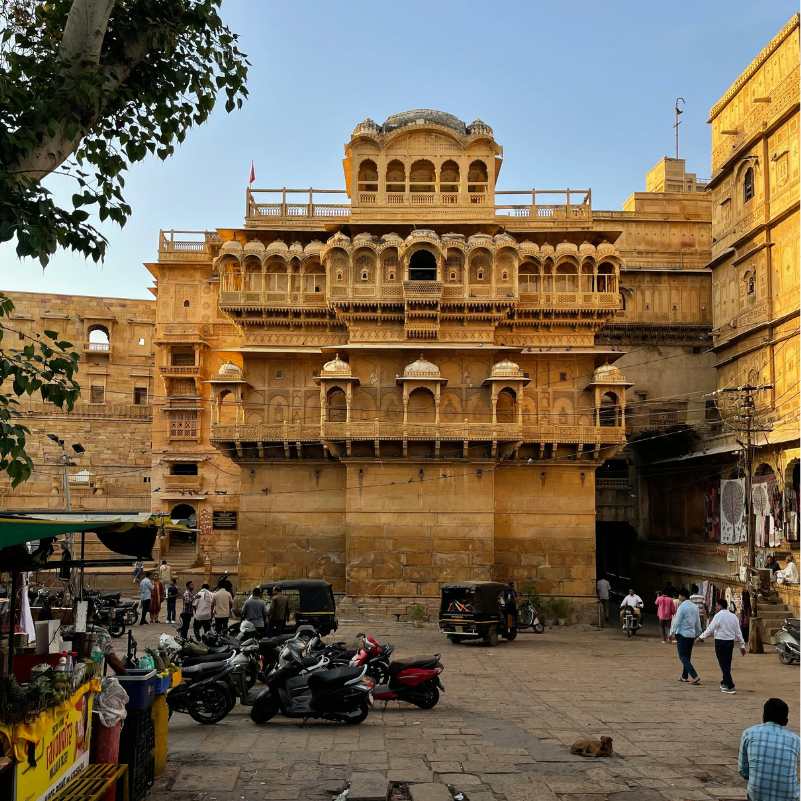
City Palace
150 m · 2 min walk
The largest palace complex in Rajasthan, about 150 metres from the temple. Most visitors do City Palace first and walk past Jagdish Temple on the way to or from the ghats.

Lake Pichola
300 m · 5 min walk
The main lake of Udaipur with the famous sunset boat ride from Rameshwar Ghat. About 300 metres from the temple, downhill through the old city lanes.
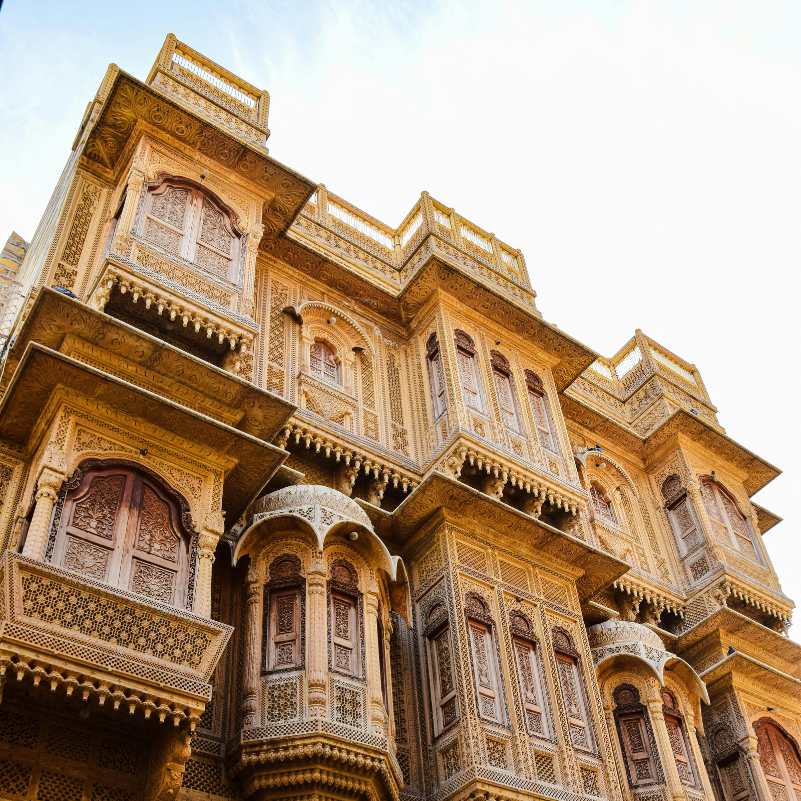
Bagore Ki Haveli
500 m · 5 min walk
An 18th century haveli turned museum on Gangaur Ghat. The Dharohar folk dance show at 7 PM is the real draw. About 500 metres from the temple.
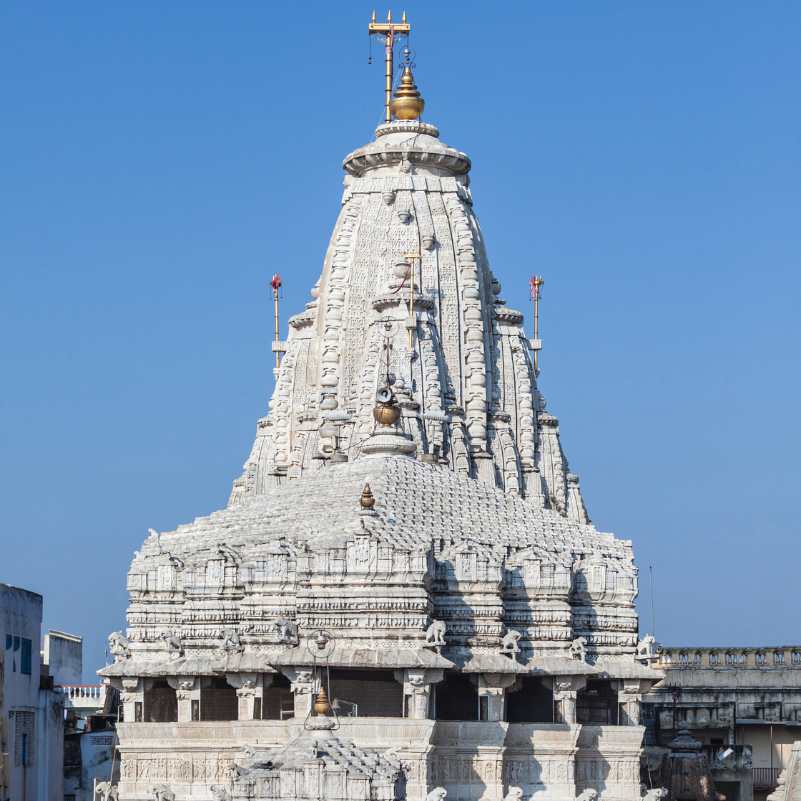
Jag Mandir
Boat ride from nearby Rameshwar Ghat
An island palace on Lake Pichola reachable by boat from Rameshwar Ghat, which is a short walk from the temple. The standard boat ride stops here.
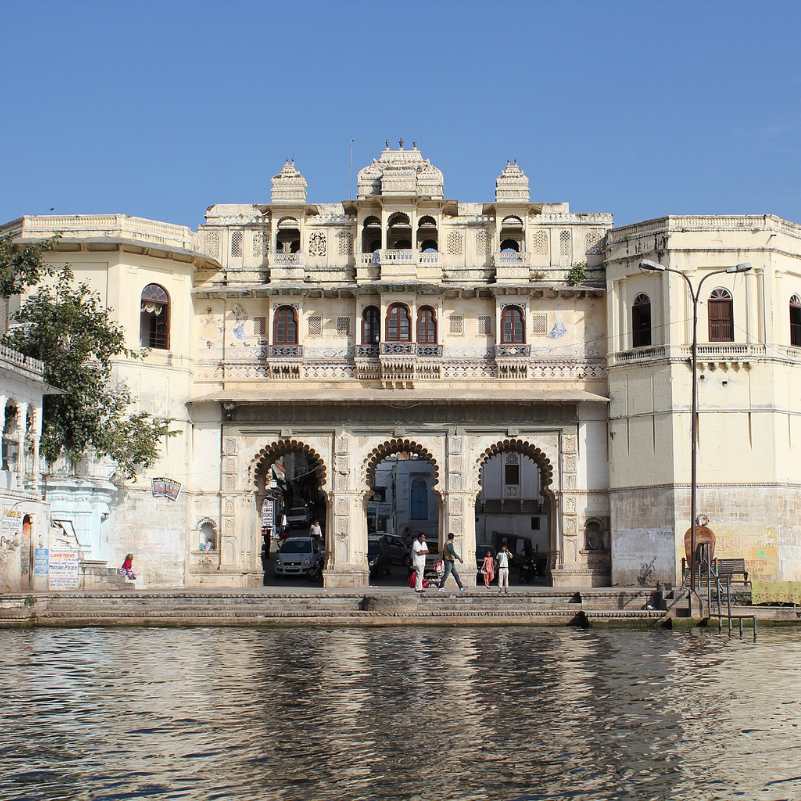
The Ghats (Gangaur Ghat, Lal Ghat)
300 to 500 m · 5 min walk
The Gangaur Ghat and Lal Ghat area starts a few minutes' walk from the temple. Rooftop restaurants, lake views, and the backpacker quarter of Udaipur.
Our packages with Jagdish Temple
Curated trips that include a visit to Jagdish Temple.
 3D/2N
3D/2NUdaipur Tour With Lake Pichola Boat Ride and Bagore Ki Haveli
3D Udaipur
₹9,999₹12,999SAVE INR 3,000/ person
FAQ
Is there an entry fee for Jagdish Temple?
No. There is no entry fee. The temple is open to everyone. It is a working place of worship.
What are the timings?
The temple generally opens early in the morning and stays open through the evening, with a possible midday closure. Timings may vary between summer and winter and during festivals. Aarti happens multiple times daily, with the morning aarti being the most attended.
How much time do I need?
20 to 30 minutes is enough to see the carved exterior, climb the steps, and look around the interior. Add 15 to 20 minutes if you want to attend aarti.
How close is it to City Palace?
About 150 metres from the Bara Pol entrance of City Palace. You will walk past it if you are going between the palace and the ghats. It is in the heart of the old city, on a raised platform visible from the surrounding streets.
Do I need to remove shoes?
Remove your shoes at the base of the 32 steps before climbing up. Dress modestly (cover shoulders and knees). Photography is generally allowed outside but may be restricted in the inner sanctum. During aarti, be respectful of the worship happening around you.
Is it worth visiting even if I am not religious?
Yes. The exterior carving work is genuinely impressive regardless of your religious interest. The shikhara covered in sculpted figures, the carved panels, and the proportions of the building are worth 15 minutes of anyone's time. You pass it on the way between City Palace and the ghats anyway.
When is the best time to visit?
Morning aarti, usually early morning. The temple fills with devotees, incense, bells, and singing. It is the most atmospheric time to visit. Midday is quiet. Late afternoon into evening also sees activity.
Is it accessible for seniors?
Yes. The 32 steps can be steep for some, but the climb is short. Inside, the temple is on a flat platform. There is no wheelchair access to the upper platform. If the steps are a problem, you can still appreciate the exterior carvings and the elephants at the base without climbing.
Related guides
Posts about Udaipur
- Udaipur to Chittorgarh Day Trip 2026: Fort Route, Timings, Cost and Honest Advice
- Udaipur Trip Cost 2026: Budget for 2, 3, 4 and 5 Days
- Udaipur Local Transport Guide 2026: Auto, Taxi, Cab, Scooter, Parking and Old-City Access
- Udaipur Food Guide 2026: Famous Dishes, Street Food and Lake View Cafes
- Udaipur in Winter 2026: October to February Weather, Crowds, Packing & Trip Plan
- Udaipur Boat Ride Guide 2026: Lake Pichola Price, Timings, Booking, Jetty & Best Sunset Slot